People in the media continue to assert their "right to know," that is, someone else's obligation to inform them, every time a story that they deem newsworthy comes out. As entertaining as the jokes about Vice President Cheney's hunting accident may have been, the story simply wasn't worth harping on for days. Cheney's mishap has no broader implications.
However, other accidents do have broader implications. We don't always hear about them, and they rarely make front page news.
How many of you knew, for example, that only weeks ago a Fairfax County, VA police officer "accidentally shot and killed an optometrist outside the unarmed man's townhouse ... as an undercover detective was about to arrest him on suspicion of gambling on sports."
Of course the media did not assert it's "right to know" when the officer's name was not divulged. According to the Washington Post, "The officer, a 17-year veteran assigned to the police tactical unit, was not identified. He was placed on leave with pay while police conduct both an internal administrative investigation and a criminal investigation."
Yet this officer's mistake cost 37-year old Salvatore Culosi his life.
Perhaps the media is more forgiving of police officers, whose job is to know how to handle weapons responsibly to protect people. While I can choose the people with whom I go hunting, I have no say in whether a police officer in my county is careful when arresting unarmed individuals. While most Americans will probably never encounter Vice President Cheney, let alone go hunting with him, many of them will encounter police officers. If news sources wanted an accident to be truly outraged about, this is it. If news sources really wanted to assert their "right to know," here's where they could do it. Instead, they are happy to drop the story without publishing the outcome of the investigation and without knowing even the officer's name.
Wednesday, February 22, 2006


Tuesday, February 14, 2006

Monday, February 13, 2006
Freedom of Speech & Religion
In the United States, we have devoted the first amendment to the Constitution to protect freedom of speech, freedom of the press, and freedom of religion. We’ve limited the role of government in deciding and enforcing all moral questions. Instead, we have designated government’s role as an alliance of people and states dedicated to protecting life, liberty and property.
However, universally it seems that people continue to run to government screaming of various perceived injustices. We allow government to take on the role of the elementary school teacher, to whom we run when the other kids make fun of us or don’t share their toys or refuse to let us join them in a game of football at recess. It is not enough that we have the right to our own lives, property and freedom. We want property belonging to others. We redefine terms like “public use.” We want our speech to be unrestricted, but insist that others do not have the right to insult us. We make up terms like “hate speech” so we can ask government to regulate what others say.
After Danish cartoonists published cartoons that negatively depicted Mohammed, a prophet according to Islam, there were more cries against freedom of speech. Arguments ranged from declaring that the press is an institution to serve the public interest to declaring that the cartoons fall under the category of “hate speech” and cannot be protected. They’ve all tried claiming that the issue is not freedom of speech, per se, but an issue of fairness or some other newly invented right.
Here are some of the arguments I’ve seen:
"The Danish cartoon controversy is not about freedom of religion versus freedom of expression, as the media is framing the debate. This is about the role of the media and journalists in our society … everyone should be respected and sensitively represented by the institutions that are intended to serve the public interest." [emphasis added]
"There is a fine line between criticism and abuse. One has the right to criticise aspects of Islam, but one should not have the right to make fun of Muslims or their faith."
(Both taken from Bangladesh news sources).
“Jyllands-Posten refused to publish caricatures of Jesus in 2003 because they would “offend” its readers. Why then is its invitation to caricature Muhammad protected by free speech provisions?” asked authors Na'eem Jeenah, Charles Amjad-Ali and Salim Vally in their article entitled, "This is Not About Freedom of Speech."
Why? As the owner of the paper and printing equipment, the newspaper can decide what it wishes to publish and what it does not. Had the newspaper chosen to publish caricatures of Jesus in 2003, those would have been protected under free speech. The decision not to offend in one instance can be motivated out of one’s moral convictions or one’s desire to keep profits high.
But the main reason why is to avoid occurrences such as this one, which are common in countries that allow the government to influence what is published or said.
"Two weekly newspaper editors charged with "harming religious feelings" by reprinting offensive caricatures of the Prophet Mohammed were released on bail Sunday after a request was made by Jordan's press watchdog." according to an Israeli newspaper.
Let’s not take the wrong lesson from the Danish cartoon controversy. We have freedom of speech not because we agree with everything that is said, but because we would like to speak when others do not necessarily agree with us. We have freedom of religion not because we believe all religions are equally valid, but because we wish to worship or refrain from worship as we choose. Freedom of speech should not come with the disclaimer that “anything you say can be held against you in a court of law.”
However, universally it seems that people continue to run to government screaming of various perceived injustices. We allow government to take on the role of the elementary school teacher, to whom we run when the other kids make fun of us or don’t share their toys or refuse to let us join them in a game of football at recess. It is not enough that we have the right to our own lives, property and freedom. We want property belonging to others. We redefine terms like “public use.” We want our speech to be unrestricted, but insist that others do not have the right to insult us. We make up terms like “hate speech” so we can ask government to regulate what others say.
After Danish cartoonists published cartoons that negatively depicted Mohammed, a prophet according to Islam, there were more cries against freedom of speech. Arguments ranged from declaring that the press is an institution to serve the public interest to declaring that the cartoons fall under the category of “hate speech” and cannot be protected. They’ve all tried claiming that the issue is not freedom of speech, per se, but an issue of fairness or some other newly invented right.
Here are some of the arguments I’ve seen:
"The Danish cartoon controversy is not about freedom of religion versus freedom of expression, as the media is framing the debate. This is about the role of the media and journalists in our society … everyone should be respected and sensitively represented by the institutions that are intended to serve the public interest." [emphasis added]
"There is a fine line between criticism and abuse. One has the right to criticise aspects of Islam, but one should not have the right to make fun of Muslims or their faith."
(Both taken from Bangladesh news sources).
“Jyllands-Posten refused to publish caricatures of Jesus in 2003 because they would “offend” its readers. Why then is its invitation to caricature Muhammad protected by free speech provisions?” asked authors Na'eem Jeenah, Charles Amjad-Ali and Salim Vally in their article entitled, "This is Not About Freedom of Speech."
Why? As the owner of the paper and printing equipment, the newspaper can decide what it wishes to publish and what it does not. Had the newspaper chosen to publish caricatures of Jesus in 2003, those would have been protected under free speech. The decision not to offend in one instance can be motivated out of one’s moral convictions or one’s desire to keep profits high.
But the main reason why is to avoid occurrences such as this one, which are common in countries that allow the government to influence what is published or said.
"Two weekly newspaper editors charged with "harming religious feelings" by reprinting offensive caricatures of the Prophet Mohammed were released on bail Sunday after a request was made by Jordan's press watchdog." according to an Israeli newspaper.
Let’s not take the wrong lesson from the Danish cartoon controversy. We have freedom of speech not because we agree with everything that is said, but because we would like to speak when others do not necessarily agree with us. We have freedom of religion not because we believe all religions are equally valid, but because we wish to worship or refrain from worship as we choose. Freedom of speech should not come with the disclaimer that “anything you say can be held against you in a court of law.”
Wednesday, February 08, 2006
Cost to Whom?
This week, President Bush sent Congress a $2.77 trillion budget plan. CNN reported on Monday that the plan "would also make his first-term tax cuts permanent, at a cost of $1.4 trillion over 10 years, and still achieve his goal of cutting the deficit in half by 2009." (Emphasis added)
The "cost" is that some taxpayers get to keep a little bit more of their money over the next decade. It does not mean that Americans have lost $1.4 trillion by 2016. Instead, that money will have been spent on goods and services that people value. It will be invested in companies, used to generate wealth and develop new technologies. Just because the money is not in the hands of bureaucrats does not mean it has disappeared.
The real cost to taxpayers is the $2.77 trillion dollars that the government spends. Regardless of whether we see any of the benefits from government programs, we are forced to bear the cost of politicians' spending whims. There's no way to 'opt out' of these programs, even if we can fully demonstrate that we are not the recipients of the benefits the programs offer. I can't say "Mr. President, I am not going to pay for your 'No Child Left Behind' initiative. I obtain no benefit from the program. I have no children, and if someday I do, I will use my own money to educate them."
According to the article, "Democrats attacked what they said were Bush's skewed priorities. They said he was trying to impose austere budgets that will harm programs for the poor while protecting tax cuts Democrats said were going primarily to the wealthy." Certainly there are some people who are better off as a result of government programs which take money from others and distribute it (in various forms) to those who did not earn it themselves. Does this mean that Democrats have a valid claim that cutting programs that helped the poor is a costs poor people? It is no more valid than if I claim that if my parents last year gave me a $100 gift certificate and this year gave me a $75 gift certificate, it has cost me $25.
Before we start labeling costs, we'd better ask ourselves one simple question: cost to whom?
The "cost" is that some taxpayers get to keep a little bit more of their money over the next decade. It does not mean that Americans have lost $1.4 trillion by 2016. Instead, that money will have been spent on goods and services that people value. It will be invested in companies, used to generate wealth and develop new technologies. Just because the money is not in the hands of bureaucrats does not mean it has disappeared.
The real cost to taxpayers is the $2.77 trillion dollars that the government spends. Regardless of whether we see any of the benefits from government programs, we are forced to bear the cost of politicians' spending whims. There's no way to 'opt out' of these programs, even if we can fully demonstrate that we are not the recipients of the benefits the programs offer. I can't say "Mr. President, I am not going to pay for your 'No Child Left Behind' initiative. I obtain no benefit from the program. I have no children, and if someday I do, I will use my own money to educate them."
According to the article, "Democrats attacked what they said were Bush's skewed priorities. They said he was trying to impose austere budgets that will harm programs for the poor while protecting tax cuts Democrats said were going primarily to the wealthy." Certainly there are some people who are better off as a result of government programs which take money from others and distribute it (in various forms) to those who did not earn it themselves. Does this mean that Democrats have a valid claim that cutting programs that helped the poor is a costs poor people? It is no more valid than if I claim that if my parents last year gave me a $100 gift certificate and this year gave me a $75 gift certificate, it has cost me $25.
Before we start labeling costs, we'd better ask ourselves one simple question: cost to whom?
Thursday, February 02, 2006
What Remedy Will the Court Prescribe?
A Washington Post headline today read, "Women Sue Wal-Mart Over Morning-After Pill."
At first, one might think that women who had taken the drug had experienced complications, that the drug was ineffective, or that it conflicted with another drug they were taking at the same time. But Wal-Mart doesn't even carry the 'morning-after' pill. That's exactly why the women are suing.
According to the Post, "Backed by abortion rights groups, three Massachusetts women sued Wal-Mart on Wednesday, accusing the retail giant of violating a state regulation by failing to stock emergency contraception pills in its pharmacies. The lawsuit, filed in state court, seeks to force the company to carry the morning-after pill in its 44 Wal-Marts and four Sam Club stores in Massachusetts." The article notes that state policy requires pharmacies to stock all "commonly prescribed medicines," and that one of Wal-Mart's competitors, CVS Pharmacy, stocks the morning-after pill in all of its stores.
To be honest, I'd never thought of it before, but now I'm considering a few similar lawsuits. I went to Nordstrom before forecasts of sleet and snow came out. Knowing that my worn tires would be slippery in snow or ice, I set out to buy some emergency tires. Believe it or not, Nordstrom actually refuses to carry tires. At other department stores located at ends of malls - Sears, for example - tires are commonly held items. Perhaps the courts can also consider forcing Nordstrom to start carrying tires.
Even more recently, I stopped by a hair salon. As I perused the products in the displays, I noticed that the salon did not carry my brand of shampoo and conditioner. How unfortunate! Normally, I'd think to go to another store to find it, not to the nearest courthouse.
The promise of profit, of enjoying one's choice of career, of providing specialized and valuable services all inspire people to take on the risk of starting a business. These entrepreneurs enable people like you and me to have what we want when we want it. They're not miracle workers or public servants. They have every right to choose which services to provide, which products to sell, when to open, when to close, and the placement and number of locations to have.
I sell my services to my employer. If for some reason, I refuse to provide a service that my company demands, the company has every right to stop purchasing my services (i.e. they can fire me). However, we would not expect to grant my company the right to obtain a court order to force me to provide a service that I refuse to provide. Like the Wal-Mart shopper who can't find the products she's looking for, my company would simply take its pocketbook elsewhere.
At first, one might think that women who had taken the drug had experienced complications, that the drug was ineffective, or that it conflicted with another drug they were taking at the same time. But Wal-Mart doesn't even carry the 'morning-after' pill. That's exactly why the women are suing.
According to the Post, "Backed by abortion rights groups, three Massachusetts women sued Wal-Mart on Wednesday, accusing the retail giant of violating a state regulation by failing to stock emergency contraception pills in its pharmacies. The lawsuit, filed in state court, seeks to force the company to carry the morning-after pill in its 44 Wal-Marts and four Sam Club stores in Massachusetts." The article notes that state policy requires pharmacies to stock all "commonly prescribed medicines," and that one of Wal-Mart's competitors, CVS Pharmacy, stocks the morning-after pill in all of its stores.
To be honest, I'd never thought of it before, but now I'm considering a few similar lawsuits. I went to Nordstrom before forecasts of sleet and snow came out. Knowing that my worn tires would be slippery in snow or ice, I set out to buy some emergency tires. Believe it or not, Nordstrom actually refuses to carry tires. At other department stores located at ends of malls - Sears, for example - tires are commonly held items. Perhaps the courts can also consider forcing Nordstrom to start carrying tires.
Even more recently, I stopped by a hair salon. As I perused the products in the displays, I noticed that the salon did not carry my brand of shampoo and conditioner. How unfortunate! Normally, I'd think to go to another store to find it, not to the nearest courthouse.
The promise of profit, of enjoying one's choice of career, of providing specialized and valuable services all inspire people to take on the risk of starting a business. These entrepreneurs enable people like you and me to have what we want when we want it. They're not miracle workers or public servants. They have every right to choose which services to provide, which products to sell, when to open, when to close, and the placement and number of locations to have.
I sell my services to my employer. If for some reason, I refuse to provide a service that my company demands, the company has every right to stop purchasing my services (i.e. they can fire me). However, we would not expect to grant my company the right to obtain a court order to force me to provide a service that I refuse to provide. Like the Wal-Mart shopper who can't find the products she's looking for, my company would simply take its pocketbook elsewhere.
Tuesday, January 31, 2006
The Business of Solving Crime
Chicago's Mayor Daley has endorsed legislation to mandate that licensed Chicago businesses open more than 12 hours per day install both indoor and outdoor surveillance cameras. This, Mayor Daley believes, will lead to a reduction in crime and will help police solve crimes that occur. He said, ""Block clubs, community organizations want cameras. ... They can't walk down the street. ... Their kids have to go around a corner away from the gang-bangers. You can't walk to church. You can't get on the CTA. ... Cameras really prevent much crime. Cameras also solve a lot of crime. The terrorist attacks in London were solved by cameras. The whole incident was solved by cameras," according to the Chicago Sun-Times.
Mayor Daley is correct in saying that installation of surveillance systems serves as both a deterrent to crime and a tool in solving crimes. However, Mayor Daley is still wrong to propose legislation mandating that businesses open over 12 hours per day install cameras.
Just how many cameras are we talking about? According to Chicagoland Chamber of Commerce President Jerry Roper, 12,000 businesses are open in Chicago for more than 12 hours per day, many of them restaurants and hotels. "Some places will take a look at the cost and say, 'We'll only be open for one shift or a shift and a half. They'll take a look at their last two hours and say, 'I'm not making that much anyway. I'll just close earlier.' Employees will lose that money," Roper said.
According to the article in the Chicago Sun-Times, "[l]ast week, business leaders lined up in opposition to the mandate on grounds it could add anywhere from $5,000 to $20,000 to their costs -- even before monitoring expenses." Apparently, businesses are not buying into the idea that installing cameras will be a smart move. Perhaps they do not perceive as high a crime risk as elected officials do. Had the business owners thought that the risk of being robbed was sufficiently high, and the cost of being robbed was also high, they would have already taken precautions such as installing cameras. Instead, businesses often take less costly precautions. They may keep less cash on hand, store valuables in safes, have alarm systems for after hours, etc. For cost effective solutions to crime, I'd trust the business owners themselves over Chicago's Mayor Daley.
Mayor Daley is correct in saying that installation of surveillance systems serves as both a deterrent to crime and a tool in solving crimes. However, Mayor Daley is still wrong to propose legislation mandating that businesses open over 12 hours per day install cameras.
Just how many cameras are we talking about? According to Chicagoland Chamber of Commerce President Jerry Roper, 12,000 businesses are open in Chicago for more than 12 hours per day, many of them restaurants and hotels. "Some places will take a look at the cost and say, 'We'll only be open for one shift or a shift and a half. They'll take a look at their last two hours and say, 'I'm not making that much anyway. I'll just close earlier.' Employees will lose that money," Roper said.
According to the article in the Chicago Sun-Times, "[l]ast week, business leaders lined up in opposition to the mandate on grounds it could add anywhere from $5,000 to $20,000 to their costs -- even before monitoring expenses." Apparently, businesses are not buying into the idea that installing cameras will be a smart move. Perhaps they do not perceive as high a crime risk as elected officials do. Had the business owners thought that the risk of being robbed was sufficiently high, and the cost of being robbed was also high, they would have already taken precautions such as installing cameras. Instead, businesses often take less costly precautions. They may keep less cash on hand, store valuables in safes, have alarm systems for after hours, etc. For cost effective solutions to crime, I'd trust the business owners themselves over Chicago's Mayor Daley.
Thursday, January 26, 2006
All's Fair in Law & Politics
If you can't beat 'em, sue 'em! At least that seems to be Saddam Hussein's strategy now.
The former Iraq dictator is bringing a lawsuit against President George W. Bush and Prime Minister Tony Blair for, of all things, using weapons of mass destruction in the commission of war crimes. Hussein's lawyers say that they plan to sue in the International Criminal Court in the Hague. According to the Washington Times, Bush and Blair have been accused of "destroying Iraq" and "committing war crimes by using weapons of mass destruction and internationally-banned weapons including enriched uranium and phosphoric and cluster bombs against unarmed Iraqi civilians, notably in Baghdad, Fallujah, Ramadi, al-Kaem and Anbar ... The suit also accuses the U.S. president and British prime minister of torturing Iraqi prisoners, destroying Iraq's cultural heritage with the aim of eliminating an ancient civilization, and inciting internal strife. "
Last, but not least, we find that Hussein is not only a concerned Iraqi, but an environmentalist, also accusing Bush and Blair "of polluting Iraq's air, waters and environment." Perhaps there is some truth to the hypothesis Walter Williams put forth in his August 31, 2005 article, "What's a way for OPEC to gain more power? I have a hypothesis, for which I have no evidence, but it ought to be tested. If I were an OPEC big cheese, I'd easily conclude that I could restrict output and charge higher oil prices if somehow U.S. oil drilling were restricted. I'd see U.S. environmental groups as allies, and I would make "charitable" contributions to assist their efforts to reduce U.S. output."
According to a Yahoo news source, "Saddam also wants all Iraqis who have had relatives killed or had property damaged [to] receive at least $500,000 each." With his newly discovered strategy, perhaps Hussein still has a career in politics. Five hundred thousand dollars, especially in Iraq, is a much better deal than "middle-class tax cuts."
The former Iraq dictator is bringing a lawsuit against President George W. Bush and Prime Minister Tony Blair for, of all things, using weapons of mass destruction in the commission of war crimes. Hussein's lawyers say that they plan to sue in the International Criminal Court in the Hague. According to the Washington Times, Bush and Blair have been accused of "destroying Iraq" and "committing war crimes by using weapons of mass destruction and internationally-banned weapons including enriched uranium and phosphoric and cluster bombs against unarmed Iraqi civilians, notably in Baghdad, Fallujah, Ramadi, al-Kaem and Anbar ... The suit also accuses the U.S. president and British prime minister of torturing Iraqi prisoners, destroying Iraq's cultural heritage with the aim of eliminating an ancient civilization, and inciting internal strife. "
Last, but not least, we find that Hussein is not only a concerned Iraqi, but an environmentalist, also accusing Bush and Blair "of polluting Iraq's air, waters and environment." Perhaps there is some truth to the hypothesis Walter Williams put forth in his August 31, 2005 article, "What's a way for OPEC to gain more power? I have a hypothesis, for which I have no evidence, but it ought to be tested. If I were an OPEC big cheese, I'd easily conclude that I could restrict output and charge higher oil prices if somehow U.S. oil drilling were restricted. I'd see U.S. environmental groups as allies, and I would make "charitable" contributions to assist their efforts to reduce U.S. output."
According to a Yahoo news source, "Saddam also wants all Iraqis who have had relatives killed or had property damaged [to] receive at least $500,000 each." With his newly discovered strategy, perhaps Hussein still has a career in politics. Five hundred thousand dollars, especially in Iraq, is a much better deal than "middle-class tax cuts."
Monday, January 23, 2006
Separating Church & State
In Italy, a complaint against the Roman Catholic Church has been filed by an atheist who claims that it has fraudulently deceived people by claiming that Jesus existed. According to CNN,
Here's a question: if a complaint such as this one were filed in the United States, would any court ruling inherently violate the principle of separation of church and state? Would the state's ruling serve to respect one religion over another or prohibit the free exercise thereof?
If the complaint took place in the United States, one would certainly ask how a lifelong atheist would have standing; as a lifelong atheist, who has himself claimed to be "born against Christ and God," it is not likely that he has personally been a victim of fraud by the Roman Catholic Church.
In the United States, the question of whether the Christ exists is not one for government to answer.
Lawyers for a small-town parish priest have been ordered to appear in court next week after the Roman Catholic cleric was accused of unlawfully asserting what many people take for granted: that Jesus Christ existed. The Rev. Enrico Righi was named in a 2002 complaint filed by Luigi Cascioli after Righi wrote in a parish bulletin that Jesus did indeed exist, and that he was born of a couple named Mary and Joseph in Bethlehem and lived in Nazareth. Cascioli, a lifelong atheist, claims that Righi violated two Italian laws by making the assertion: so-called "abuse of popular belief" in which someone fraudulently deceives people; and "impersonation" in which someone gains by attributing a false name to someone. Cascioli says that for 2,000 years the Roman Catholic Church has been deceiving people by furthering the fable that Christ existed, and says the church has been gaining financially by "impersonating" as Christ someone by the name of John of Gamala, the son of Judas from Gamala.
Here's a question: if a complaint such as this one were filed in the United States, would any court ruling inherently violate the principle of separation of church and state? Would the state's ruling serve to respect one religion over another or prohibit the free exercise thereof?
If the complaint took place in the United States, one would certainly ask how a lifelong atheist would have standing; as a lifelong atheist, who has himself claimed to be "born against Christ and God," it is not likely that he has personally been a victim of fraud by the Roman Catholic Church.
In the United States, the question of whether the Christ exists is not one for government to answer.
Tuesday, January 17, 2006
Elementary School Lobbyists
On the agenda tomorrow for the District of Columbia Council is a public hearing to "assist the Council in selecting a fruit to be designated by an act of the Council as the official fruit of the District of Columbia."
Luckily, sixth grade students at Bowen Elementary do not have math, literature or science to study. Instead, they are researching fruits that might be appropriate as the official fruit of Washington, D.C. The story was introduced in November of 2005, when Council Chairman Linda Cropp introduced a resolution asking the elementary school students to find a suitable fruit based on its "abundance in the jurisdiction, its popularity in the jurisdiction, or for its symbolic meaning."
We might conclude that the Council has nothing better to do with its time. Au contraire - in November of last year, Council Members undertook many other tasks with taxpayers' money, including establishing the "Office of Gay, Lesbian, Bisexual and Transgender Affairs within the Executive Office of the Mayor," and establishing "standards for responsible business practices by large retailers by ensuring that they pay living wages, provide benefits, and respect free speech" through the Large Retailer Accountability Act of 2005, along with the usual tasks of making sure that you cannot park in the front lawn on private property and must use a hands-free device while driving and talking on your cell phone.
Of course, the Council Members only want to teach youngsters about the political process, as it states in the resolution: "That having school children propose an official fruit to the Council through proposed legislation will teach the children about the political process and the importance of public participation in civic life and show all our residents that all people, young and old, can get involved in politics and in their own government." After all, children should understand at a young age that all one has to do to impose his will on others is appeal to politicians to enact a law.
Luckily, sixth grade students at Bowen Elementary do not have math, literature or science to study. Instead, they are researching fruits that might be appropriate as the official fruit of Washington, D.C. The story was introduced in November of 2005, when Council Chairman Linda Cropp introduced a resolution asking the elementary school students to find a suitable fruit based on its "abundance in the jurisdiction, its popularity in the jurisdiction, or for its symbolic meaning."
We might conclude that the Council has nothing better to do with its time. Au contraire - in November of last year, Council Members undertook many other tasks with taxpayers' money, including establishing the "Office of Gay, Lesbian, Bisexual and Transgender Affairs within the Executive Office of the Mayor," and establishing "standards for responsible business practices by large retailers by ensuring that they pay living wages, provide benefits, and respect free speech" through the Large Retailer Accountability Act of 2005, along with the usual tasks of making sure that you cannot park in the front lawn on private property and must use a hands-free device while driving and talking on your cell phone.
Of course, the Council Members only want to teach youngsters about the political process, as it states in the resolution: "That having school children propose an official fruit to the Council through proposed legislation will teach the children about the political process and the importance of public participation in civic life and show all our residents that all people, young and old, can get involved in politics and in their own government." After all, children should understand at a young age that all one has to do to impose his will on others is appeal to politicians to enact a law.
Friday, January 13, 2006
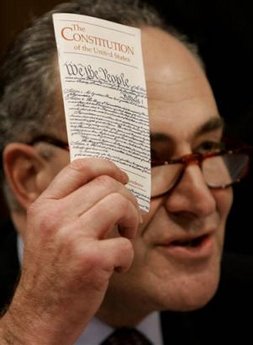
I say we all pitch in and get them the large print version.
Photo of Sen. Charles Schumer from drudgereport.com
Thursday, January 12, 2006
Roe v. Wade v. Alito?
Regardless of what Samuel Alito's opinion may or may not be on abortion, democrats are grasping at straws with Alito's supposed attempts to undermine Roe v. Wade.
In particular, they cite Alito's dissent in a 1992 case in Pennsylvania, Planned Parenthood of Southeastern Pennsylvania v. Casey. At that time, Pennsylvania had a law which required that a married woman seeking an abortion notify her husband first. Note that the law clearly did not require the consent of the husband -- only notification. The law also made exceptions for women who believed that telling their husbands could threaten their safety. It hardly amounted to a threat to Roe v. Wade and did nothing to limit a woman's ability to obtain an abortion. No one on the pro-life side would have seen the law as a victory in even the most minute sense of the word.
However, former head of the NARAL Pro-Choice America, Kate Michelman, was quoted saying, "What we need to get at here is how Judge Alito could have believed that forcing women to notify their husbands before having an abortion was not an undue burden on women. That opinion treated women like little girls."
Rather than restricting the ability of a woman to abort her child, the law merely required the married woman to behave as though she was, well ... married. To ask the government to legally recognize a marriage between a specific man and woman is to ask that the man and woman be treated as a unit. Assuming that marriage is voluntary, the man and woman have both agreed to this union and the accompanying treatment under the law. There's a very simple way to avoid the responsibilities that come with marriage: don't get married.
If voting to uphold the Pennsylvania law constitutes an attempt to overturn Roe v. Wade, perhaps we should be concerned that upholding the Kelo v. New London decision constitutes an attack on a woman's right to property. Perhaps we should be more concerned that a woman's right to keep and bear arms is under attack by more than just laws requiring the woman to inform her husband of her gun collection stored in the basement (unless, of course, telling him could threaten her safety). Perhaps we should question whether a woman truly has the right to her own body, when she must not only notify but receive the consent of a doctor to obtain medicine or when the FDA decides what she is permitted to use to treat pain and illness.
If violating Constitutional rights is no longer in vogue, someone needs to inform the politicians in the confirmation hearings. Before they point the finger at Alito, a good look in the mirror might just be in order.
In particular, they cite Alito's dissent in a 1992 case in Pennsylvania, Planned Parenthood of Southeastern Pennsylvania v. Casey. At that time, Pennsylvania had a law which required that a married woman seeking an abortion notify her husband first. Note that the law clearly did not require the consent of the husband -- only notification. The law also made exceptions for women who believed that telling their husbands could threaten their safety. It hardly amounted to a threat to Roe v. Wade and did nothing to limit a woman's ability to obtain an abortion. No one on the pro-life side would have seen the law as a victory in even the most minute sense of the word.
However, former head of the NARAL Pro-Choice America, Kate Michelman, was quoted saying, "What we need to get at here is how Judge Alito could have believed that forcing women to notify their husbands before having an abortion was not an undue burden on women. That opinion treated women like little girls."
Rather than restricting the ability of a woman to abort her child, the law merely required the married woman to behave as though she was, well ... married. To ask the government to legally recognize a marriage between a specific man and woman is to ask that the man and woman be treated as a unit. Assuming that marriage is voluntary, the man and woman have both agreed to this union and the accompanying treatment under the law. There's a very simple way to avoid the responsibilities that come with marriage: don't get married.
If voting to uphold the Pennsylvania law constitutes an attempt to overturn Roe v. Wade, perhaps we should be concerned that upholding the Kelo v. New London decision constitutes an attack on a woman's right to property. Perhaps we should be more concerned that a woman's right to keep and bear arms is under attack by more than just laws requiring the woman to inform her husband of her gun collection stored in the basement (unless, of course, telling him could threaten her safety). Perhaps we should question whether a woman truly has the right to her own body, when she must not only notify but receive the consent of a doctor to obtain medicine or when the FDA decides what she is permitted to use to treat pain and illness.
If violating Constitutional rights is no longer in vogue, someone needs to inform the politicians in the confirmation hearings. Before they point the finger at Alito, a good look in the mirror might just be in order.
Wednesday, January 11, 2006
Lincoln, the South & the Civil War
John V. Denson at lewrockwell.com wrote an informative article yesterday on the Civil War. It begins,
The pervasive myth that the Civil War (the War Between the States or the War of Northern Aggression) was fought over slavery bypasses any reasonable debate over the merits of a decentralized government and 'states' rights' from a overly powerful federal government. Instead, history books proclaim Lincoln as the "Great Emancipator," conveniently ignoring that the Emancipation Proclamation was purely a tactical move to win the war and only applied to states that would not renounce their intentions to secede.
Read Denson's article. It provides a historical account that you are not likely to find in your average history book.
Most establishment historians today might as well be the Orwellian historians writing for the Ministry of Truth in George Orwell’s novel 1984, especially in relation to the War Between the States. They rarely, if ever, mention the Hampton Roads Peace Conference which occurred in February of 1865, because it brings into question most of the mythology promoted today which states that Lincoln and the North fought the war for the purpose of abolishing slavery and the South fought for the purpose of protecting it, and therefore, it was a great and noble war.
The pervasive myth that the Civil War (the War Between the States or the War of Northern Aggression) was fought over slavery bypasses any reasonable debate over the merits of a decentralized government and 'states' rights' from a overly powerful federal government. Instead, history books proclaim Lincoln as the "Great Emancipator," conveniently ignoring that the Emancipation Proclamation was purely a tactical move to win the war and only applied to states that would not renounce their intentions to secede.
Read Denson's article. It provides a historical account that you are not likely to find in your average history book.
Sunday, January 08, 2006
Why Worry?
The news has been providing continuous updates on Ariel Sharon, prime minister of Israel, who suffered a massive stroke. Many have expressed concerns over potential consequences of Sharon's death or inability to resume the position of prime minister.
One article references a reason why Israelis may be concerned, noting that: "Israelis from all walks of life have lamented Sharon's likely departure from the political scene because, with his larger-than life persona and warrior credentials, Sharon was widely seen as the man most capable of untangling the Israeli-Palestinian conflict."
Generally speaking, Americans are less concerned about the health of the president or other high ranking elected officials. We feel that we can worry less about who might take the place of a leader, because to some extent we trust the measures in place to check the power of our leaders. This is not the case in many other countries.
Many countries have relied heavily on their leaders to maintain stability, order, and peace. In doing so, they have sacrificed the autonomy that limited government provides. By allowing their leaders such a pivotal role, they have put all of the proverbial eggs in one basket. In the event that the leader is no longer able to rule, the people are left to wonder what will become of them. Who will provide them with stability? Who will make laws? Who will tell them the proper way to tie their shoes or which end of the egg to break?
Truly we can draw a valuable lesson from observing others worry over the fate of their leaders. Knowing that we can capably lead ourselves and ensuring that our leaders do not have the ability to destroy the work of others will allow us to worry less about who is in power, but rather worry about how much power we allow our leaders to have.
One article references a reason why Israelis may be concerned, noting that: "Israelis from all walks of life have lamented Sharon's likely departure from the political scene because, with his larger-than life persona and warrior credentials, Sharon was widely seen as the man most capable of untangling the Israeli-Palestinian conflict."
Generally speaking, Americans are less concerned about the health of the president or other high ranking elected officials. We feel that we can worry less about who might take the place of a leader, because to some extent we trust the measures in place to check the power of our leaders. This is not the case in many other countries.
Many countries have relied heavily on their leaders to maintain stability, order, and peace. In doing so, they have sacrificed the autonomy that limited government provides. By allowing their leaders such a pivotal role, they have put all of the proverbial eggs in one basket. In the event that the leader is no longer able to rule, the people are left to wonder what will become of them. Who will provide them with stability? Who will make laws? Who will tell them the proper way to tie their shoes or which end of the egg to break?
Truly we can draw a valuable lesson from observing others worry over the fate of their leaders. Knowing that we can capably lead ourselves and ensuring that our leaders do not have the ability to destroy the work of others will allow us to worry less about who is in power, but rather worry about how much power we allow our leaders to have.
Thursday, January 05, 2006
Mining for Regulations
It was sad to hear of the mining accident that occurred at the beginning of this week, in which twelve miners were killed after an explosion in a West Virginia mine.
In typical reactionary fashion, many people have suggested establishing stricter safety regulations for mines. Naturally, they hope that more stringent requirements will result in fewer deaths and injuries. BBC News notes that while the U.S. has significantly fewer mining deaths than China (30/year in the U.S. compared to China with 8,000/year), the current requirements of "at least four mandatory inspections by the Mine Safety and Health Administration each year" and penalties ranging up to $60,000 per safety violation may not be enough. Claudia Cole, widow of a Kentucky coal miner who was killed last year when the roof collapsed on a mine in Harlan County, Kentucky, hopes that the tragedy will help prevent other deaths from occurring. "'[The miners are] safer than they were back in the 1930's,' Cole explains. 'But to me they're not doing everything they could. If they were, there wouldn't be these deaths.'" According to the article, Cole would like to see more safety rules come from the recent mining accident. An NPR interview cites "[t]ougher government regulation and technology improvements" as the reason why mining accidents have decreased over the past two decades. Davitt McAteer, former assistant secretary for mine safety and health at the Department of Labor, says, "Trouble is, no matter how many safety measures we introduce into the workplace, the dangers are recreated every 24 hours ... Miners have to be a lot more vigilant than other workers."
Miners understand quite well that their job is a dangerous one. They do not take these risks blindly. For their level of education, they are highly compensated due to the risky nature of the profession. If the workers truly wanted a safer job, they would settle for one that requires the same level of skill and would inevitably pay less.
As much as I dislike hearing stories of miners killed in accidents, the risk level that the miners take is not mine to decide. The amount of additional compensation for risk is not mine to take away. Safety isn't free.
We all take risks, and I would venture to say that we all take risks with our own lives if we feel the benefit exceeds the risk of an undesirable outcome. I drive a convertible sportscar. It's not the safest car in the world, but I knowingly take the risk of driving a car that would not survive a major accident. Members of my family would prefer that I drive a safer car and sacrifice the enjoyment I derive from my current vehicle. Luckily, they have not yet appealed to the government to impose safety regulations that my car would not pass. Just as miners exercise greater caution while they are at work in the mines, I exercise greater caution while driving as another way to counter the risk that my surroundings impose. Regardless of how insignificant my personal example is, the principle applies equally to other risky scenarios.
As we enter 2006, let's not start out with additional regulations, but leave important decisions to those whom they will affect.
In typical reactionary fashion, many people have suggested establishing stricter safety regulations for mines. Naturally, they hope that more stringent requirements will result in fewer deaths and injuries. BBC News notes that while the U.S. has significantly fewer mining deaths than China (30/year in the U.S. compared to China with 8,000/year), the current requirements of "at least four mandatory inspections by the Mine Safety and Health Administration each year" and penalties ranging up to $60,000 per safety violation may not be enough. Claudia Cole, widow of a Kentucky coal miner who was killed last year when the roof collapsed on a mine in Harlan County, Kentucky, hopes that the tragedy will help prevent other deaths from occurring. "'[The miners are] safer than they were back in the 1930's,' Cole explains. 'But to me they're not doing everything they could. If they were, there wouldn't be these deaths.'" According to the article, Cole would like to see more safety rules come from the recent mining accident. An NPR interview cites "[t]ougher government regulation and technology improvements" as the reason why mining accidents have decreased over the past two decades. Davitt McAteer, former assistant secretary for mine safety and health at the Department of Labor, says, "Trouble is, no matter how many safety measures we introduce into the workplace, the dangers are recreated every 24 hours ... Miners have to be a lot more vigilant than other workers."
Miners understand quite well that their job is a dangerous one. They do not take these risks blindly. For their level of education, they are highly compensated due to the risky nature of the profession. If the workers truly wanted a safer job, they would settle for one that requires the same level of skill and would inevitably pay less.
As much as I dislike hearing stories of miners killed in accidents, the risk level that the miners take is not mine to decide. The amount of additional compensation for risk is not mine to take away. Safety isn't free.
We all take risks, and I would venture to say that we all take risks with our own lives if we feel the benefit exceeds the risk of an undesirable outcome. I drive a convertible sportscar. It's not the safest car in the world, but I knowingly take the risk of driving a car that would not survive a major accident. Members of my family would prefer that I drive a safer car and sacrifice the enjoyment I derive from my current vehicle. Luckily, they have not yet appealed to the government to impose safety regulations that my car would not pass. Just as miners exercise greater caution while they are at work in the mines, I exercise greater caution while driving as another way to counter the risk that my surroundings impose. Regardless of how insignificant my personal example is, the principle applies equally to other risky scenarios.
As we enter 2006, let's not start out with additional regulations, but leave important decisions to those whom they will affect.
Monday, January 02, 2006
Separating Money & Power
A reader asked me an excellent question last week: What is the proper separation between private businesses and government?
It is true that businesses often influence government by lobbying for legislation in their favor. Why is government influenced at all by businesses? The answer is simple - because government has the power to grant them favors that will amount to millions of dollars.
Complaints of the intermingling of government and private companies come from both the right and left. Democrats complain of Republican administrations awarding contracts to private companies without requiring companies to bid on them (Halliburton & the George W. Bush administration), and Republicans complain of Democratic administrations allowing dishonest executives to spend the night in the White House and giving them huge subsidies (Enron's Kenneth Lay & the Clinton administration).
Both complaints miss the point. The problem is not with one administration or another (although one does not have to look far to find them). Instead, the problem is that government has gained the unconstitutional ability to pass laws that benefit some at the expense of others.
I may have directed readers to Bastiat's work previously, but it is worth rereading. 'The Law' describes what Bastiat terms "legal plunder" and suggests, "the proper purpose of law is to use the power of its collective force to stop this fatal tendency to plunder instead of to work. All the measures of the law should protect property and punish plunder. But, generally, the law is made by one man or one class of men. And since law cannot operate without the sanction and support of a dominating force, this force must be entrusted to those who make the laws. This fact, combined with the fatal tendency that exists in the heart of man to satisfy his wants with the least possible effort, explains the almost universal perversion of the law. Thus it is easy to understand how law, instead of checking injustice, becomes the invincible weapon of injustice. It is easy to understand why the law is used by the legislator to destroy in varying degrees among the rest of the people, their personal independence by slavery, their liberty by oppression, and their property by plunder. This is done for the benefit of the person who makes the law, and in proportion to the power that he holds ... God has given to men all that is necessary for them to accomplish their destinies. He has provided a social form as well as a human form. And these social organs of persons are so constituted that they will develop themselves harmoniously in the clean air of liberty. Away, then, with quacks and organizers! Away with their rings, chains, hooks, and pincers! Away with their artificial systems! Away with the whims of governmental administrators, their socialized projects, their centralization, their tariffs, their government schools, their state religions, their free credit, their bank monopolies, their regulations, their restrictions, their equalization by taxation, and their pious moralizations! And now that the legislators and do-gooders have so futilely inflicted so many systems upon society, may they finally end where they should have begun: May they reject all systems, and try liberty; for liberty is an acknowledgment of faith in God and His works."
It is true that businesses often influence government by lobbying for legislation in their favor. Why is government influenced at all by businesses? The answer is simple - because government has the power to grant them favors that will amount to millions of dollars.
Complaints of the intermingling of government and private companies come from both the right and left. Democrats complain of Republican administrations awarding contracts to private companies without requiring companies to bid on them (Halliburton & the George W. Bush administration), and Republicans complain of Democratic administrations allowing dishonest executives to spend the night in the White House and giving them huge subsidies (Enron's Kenneth Lay & the Clinton administration).
Both complaints miss the point. The problem is not with one administration or another (although one does not have to look far to find them). Instead, the problem is that government has gained the unconstitutional ability to pass laws that benefit some at the expense of others.
I may have directed readers to Bastiat's work previously, but it is worth rereading. 'The Law' describes what Bastiat terms "legal plunder" and suggests, "the proper purpose of law is to use the power of its collective force to stop this fatal tendency to plunder instead of to work. All the measures of the law should protect property and punish plunder. But, generally, the law is made by one man or one class of men. And since law cannot operate without the sanction and support of a dominating force, this force must be entrusted to those who make the laws. This fact, combined with the fatal tendency that exists in the heart of man to satisfy his wants with the least possible effort, explains the almost universal perversion of the law. Thus it is easy to understand how law, instead of checking injustice, becomes the invincible weapon of injustice. It is easy to understand why the law is used by the legislator to destroy in varying degrees among the rest of the people, their personal independence by slavery, their liberty by oppression, and their property by plunder. This is done for the benefit of the person who makes the law, and in proportion to the power that he holds ... God has given to men all that is necessary for them to accomplish their destinies. He has provided a social form as well as a human form. And these social organs of persons are so constituted that they will develop themselves harmoniously in the clean air of liberty. Away, then, with quacks and organizers! Away with their rings, chains, hooks, and pincers! Away with their artificial systems! Away with the whims of governmental administrators, their socialized projects, their centralization, their tariffs, their government schools, their state religions, their free credit, their bank monopolies, their regulations, their restrictions, their equalization by taxation, and their pious moralizations! And now that the legislators and do-gooders have so futilely inflicted so many systems upon society, may they finally end where they should have begun: May they reject all systems, and try liberty; for liberty is an acknowledgment of faith in God and His works."
Wednesday, December 28, 2005
Exporting Crime?
Officials in Canada are blaming the United States for recent increases in violent crime. A CNN article states, "Canadian Prime Minister Paul Martin and Toronto Mayor David Miller warned that Canada could become like the United States after gunfire erupted Monday on a busy street filled with holiday shoppers, killing a 15-year-old girl and wounding six bystanders -- the latest victims in a record surge in gun violence in Toronto ... 'It's a sign that the lack of gun laws in the U.S. is allowing guns to flood across the border that are literally being used to kill people in the streets of Toronto,' Miller said. Miller said Toronto, a city of nearly three million, is still very safe compared to most American cities, but the illegal flow of weapons from the United States is causing the noticeable rise in gun violence. 'The U.S. is exporting its problem of violence to the streets of Toronto,' he said. Miller said that while almost every other crime in Toronto is down, the supply of guns has increased and half of them come from the United States."
Regions with strict gun control legislation often blame neighboring areas for "exporting crime" when the neighboring areas have fewer restrictions on firearms. They cite that the guns used to commit crimes often come from areas where firearms are less restricted. The idea is not new. In 2003, a group calling themselves "Americans for Gun Safety" issued a report stating that Georgia was exporting firearms used to commit crimes in other states. The report included, among other things, a list of the "top ten crime gun exporting states," alleging that:
It is not areas with less gun control that have more crime. Instead, we see a flow of crime towards areas with fewer guns. Why?
Contrary to what many proponents of gun control believe, there are significant positive externalities from residing in an area with many gun owners, particularly when individuals are permitted to carry firearms concealed from view. Perhaps your .45 clashes with your outfit one day, perhaps it is inconvenient for you to carry a gun with you everywhere, or perhaps you hate guns and would never dream of owning one. A criminal has no way of knowing that you are unarmed.
In Virginia, carrying handguns openly is legal and carrying them so that they are concealed and accessible is legal with a concealed carry permit. In Washington, D.C., neither is legal. If we compare the crime statistics between Washington, D.C. and Fairfax County, VA, we see that crime is much higher in D.C. than in Virginia. In 2000, there were two murders reported in Fairfax County, with a population of nearly 1 million. In the same year, 239 murders were reported in the District of Columbia, with a population amounting to less than 600,000.
The United States is not exporting crime to Canada, nor is Virginia exporting crime to D.C. Instead, it is the gun control legislation in Canada and D.C. that produces helpless targets on which criminals prey.
Regions with strict gun control legislation often blame neighboring areas for "exporting crime" when the neighboring areas have fewer restrictions on firearms. They cite that the guns used to commit crimes often come from areas where firearms are less restricted. The idea is not new. In 2003, a group calling themselves "Americans for Gun Safety" issued a report stating that Georgia was exporting firearms used to commit crimes in other states. The report included, among other things, a list of the "top ten crime gun exporting states," alleging that:
"Of the 109,870 crime guns traced by BATF in 2001, 36,828 (33.5%) were originally purchased in one state and used in crime in another. The top ten crime gun export states in 2001 were:(Note: I would be reluctant to take the statistical evidence presented above as fact. The report states that criminal background checks are not required at gun shows, a statement which is blatantly false. Contrary to the "gun show loophole" myth, it is federally mandated that all engaged in the business of selling firearms call the FBI prior to every sale, regardless of whether the sale is from a store or a gun show. The FBI runs an instant criminal background check and authorizes the sale.)
1. Virginia – 2,489 crime gun exports
2. Georgia – 2,428
3. California – 2,228
4. Florida – 2,048
5. Texas – 1,851
6. Mississippi – 1,772
7. Ohio – 1,697
8. Indiana – 1,684
9. North Carolina – 1,454
10. Alabama – 1,301
Of these leading crime gun exporting states, only California and North Carolina require criminal background checks for all handgun and assault rifle sales at gun shows. In fact, on average the states that have failed to close the gun show loophole are the source of 53.4% more crime gun exports than states that have closed this loophole. In a published federal report, BATF indicated that gun shows were the second leading source of firearms recovered in illegal gun trafficking investigations. This finding is borne out in the raw data from 2001, which show that almost none of the top crime gun exporting states require criminal background checks for unlicensed firearms sales at gun shows."
It is not areas with less gun control that have more crime. Instead, we see a flow of crime towards areas with fewer guns. Why?
Contrary to what many proponents of gun control believe, there are significant positive externalities from residing in an area with many gun owners, particularly when individuals are permitted to carry firearms concealed from view. Perhaps your .45 clashes with your outfit one day, perhaps it is inconvenient for you to carry a gun with you everywhere, or perhaps you hate guns and would never dream of owning one. A criminal has no way of knowing that you are unarmed.
In Virginia, carrying handguns openly is legal and carrying them so that they are concealed and accessible is legal with a concealed carry permit. In Washington, D.C., neither is legal. If we compare the crime statistics between Washington, D.C. and Fairfax County, VA, we see that crime is much higher in D.C. than in Virginia. In 2000, there were two murders reported in Fairfax County, with a population of nearly 1 million. In the same year, 239 murders were reported in the District of Columbia, with a population amounting to less than 600,000.
The United States is not exporting crime to Canada, nor is Virginia exporting crime to D.C. Instead, it is the gun control legislation in Canada and D.C. that produces helpless targets on which criminals prey.
Saturday, December 24, 2005
Legal to Give, Illegal to Sell
Stories like this one showcase the generous, caring nature of individuals who are willing to go through risky surgeries to donate a kidney to save the life of another person. With well known sayings like, "'tis better to give than to receive," who can deny that giving up an organ is a noble thing to do?
While it may be better to give than to receive, the truth is that few people choose to give up an organ during the course of their lives, especially to a stranger. We hear of cases where someone has donated a kidney to a loved one, but rarely do we hear of cases where someone has donated a kidney to a complete stranger. The reasons are obvious. The surgery is inherently risky, the recovery can be costly and difficult, and the gain is limited by law to the warm fuzzy feeling obtained from helping someone.
From elementary economics, we know that when maximum prices are imposed on a valued item, the quantity supplied declines. In this case, the maximum price is zero. Naturally, the number of organs supplied decreases. For this reason, people wait for years for a matching donor, and often die waiting.
It is selfish to demand that people's generosity be the only means of obtaining an organ because we don't like the idea of profit-motivated people selling a kidney to a dying person. Should I be required to rely on the generosity of others for food, shelter, medicine or other items necessary for me to live? I would expect that I would be much less likely to obtain any of those items and stories about how a generous food donor saved my life would start making headlines.
While it may be better to give than to receive, the truth is that few people choose to give up an organ during the course of their lives, especially to a stranger. We hear of cases where someone has donated a kidney to a loved one, but rarely do we hear of cases where someone has donated a kidney to a complete stranger. The reasons are obvious. The surgery is inherently risky, the recovery can be costly and difficult, and the gain is limited by law to the warm fuzzy feeling obtained from helping someone.
From elementary economics, we know that when maximum prices are imposed on a valued item, the quantity supplied declines. In this case, the maximum price is zero. Naturally, the number of organs supplied decreases. For this reason, people wait for years for a matching donor, and often die waiting.
It is selfish to demand that people's generosity be the only means of obtaining an organ because we don't like the idea of profit-motivated people selling a kidney to a dying person. Should I be required to rely on the generosity of others for food, shelter, medicine or other items necessary for me to live? I would expect that I would be much less likely to obtain any of those items and stories about how a generous food donor saved my life would start making headlines.
Friday, December 23, 2005
Bundling Up for Alaska
I see no benefit to myself of knowing that there are acres of pristine ice & snow in Alaska where elk and caribou may run freely without having to look at mechanisms for extracting oil. I’ve never actually interviewed the wildlife in Alaska to ask if they share the Sierra Club’s aversion to all things “not natural.” My hunch is that we humans find “unnatural” structures more repulsive than do the animals on which we have projected our preferences.
Regardless, Sen. Ted Stevens’ combining drilling in ANWR with a defense spending bill is like trying to sell a carton of eggs with a margarita. Unfortunately in voting, it’s an all-or-nothing deal. Like many Democrats, I would have voted against the measure as well – but not because of my ties to environmentalists or my aversion to drilling for oil in Alaska, but because I would not have voted to spend more of other people’s money on the troops and Katrina victims. Of course, I didn’t hear anyone complaining about the “$2 billion to help low-income households pay this winter's heating expenses,” also contained in the bill.
The term ‘bundling’ is used to describe when multiple items are packaged together as one. It can be a good sales tool by reducing the search costs of the person trying to buy related items or trying to obtain multiple functions in one item. My cell phone, for example, combines the functions of a voice recorder, camera, phone, calendar, and alarm clock with some other features I never use. Bundling is an effective technique in politics, and I can’t really fault Stevens’ attempts to use it. Politicians use this technique all of the time. We are always voting for package deals when we elect candidates. We can’t choose the features we like from one candidate and the features we like from the other candidate. Instead, we take the qualities we like with the qualities we don’t.
Regardless, Sen. Ted Stevens’ combining drilling in ANWR with a defense spending bill is like trying to sell a carton of eggs with a margarita. Unfortunately in voting, it’s an all-or-nothing deal. Like many Democrats, I would have voted against the measure as well – but not because of my ties to environmentalists or my aversion to drilling for oil in Alaska, but because I would not have voted to spend more of other people’s money on the troops and Katrina victims. Of course, I didn’t hear anyone complaining about the “$2 billion to help low-income households pay this winter's heating expenses,” also contained in the bill.
The term ‘bundling’ is used to describe when multiple items are packaged together as one. It can be a good sales tool by reducing the search costs of the person trying to buy related items or trying to obtain multiple functions in one item. My cell phone, for example, combines the functions of a voice recorder, camera, phone, calendar, and alarm clock with some other features I never use. Bundling is an effective technique in politics, and I can’t really fault Stevens’ attempts to use it. Politicians use this technique all of the time. We are always voting for package deals when we elect candidates. We can’t choose the features we like from one candidate and the features we like from the other candidate. Instead, we take the qualities we like with the qualities we don’t.
Wednesday, December 14, 2005
Don't Worry, Buy Imports
The news seems to have an infatuation with listing the latest data on the so-called trade deficit that we run with other countries, saying that "The U.S. trade deficit widened unexpectedly in October to a record $68.9 billion despite a drop in the cost of imported oil, as the deficits with China, Canada, the European Union, Mexico and OPEC all hit records, government data showed Wednesday." To set the record straight, there is no trade deficit. As I've explained before, trade with other countries is good.
Suppose you sell me a watch. I give you $20 and you give me a watch. My cash account dropped by $20, but my goods account increased by a value that I perceive to be greater than $20. (Were it an “even” exchange, I would have been indifferent between the watch and my $20 bill). To you, the $20 was worth more than the watch, so while your goods account dropped by some amount that you perceive to be less than $20, but your cash account increased by $20. Neither of us owes each other any additional amount and both of us are better off. There is no “trade deficit.”
I could have knitted the sweater I’m wearing today. But I didn’t. Someone living across the world did. Should I be concerned that some portion of my wealth went to the person who knitted my sweater? Should I be worried about my “trade deficit” with someone because they reside in another country? Of course not. Obviously I believe the person earned it and I am better off, or I would not have made the purchase in the first place.
Don't worry - buy the Swiss watch, the French wine, the Japanese car. You're not creating a "trade deficit."
Suppose you sell me a watch. I give you $20 and you give me a watch. My cash account dropped by $20, but my goods account increased by a value that I perceive to be greater than $20. (Were it an “even” exchange, I would have been indifferent between the watch and my $20 bill). To you, the $20 was worth more than the watch, so while your goods account dropped by some amount that you perceive to be less than $20, but your cash account increased by $20. Neither of us owes each other any additional amount and both of us are better off. There is no “trade deficit.”
I could have knitted the sweater I’m wearing today. But I didn’t. Someone living across the world did. Should I be concerned that some portion of my wealth went to the person who knitted my sweater? Should I be worried about my “trade deficit” with someone because they reside in another country? Of course not. Obviously I believe the person earned it and I am better off, or I would not have made the purchase in the first place.
Don't worry - buy the Swiss watch, the French wine, the Japanese car. You're not creating a "trade deficit."
Thursday, December 08, 2005
Hindsight Is Never 20/20
Suppose you are an air marshal. You observe a passenger behaving erratically, running through the aisles of the airplane. He claims to have a bomb in his carry-on luggage. Your job is to protect the passengers in the plane – and yourself. You don’t know if he is bluffing or if he actually has a bomb. In the time it takes to find out, you and the rest of the passengers (including the man claiming to have a bomb) could be dead. What do you do?
Sadly, air marshals in Florida were faced with a similar scenario yesterday afternoon. Acting on the information that they had, they chose to shoot the man rather than to risk the lives of the remaining passengers. It was later discovered that the man did not have a bomb in his possession, and was 44-year-old American, Rigoberto Alpizar. His irrational behavior may have been explained by his bipolar disorder and need for medication.
It is easy and far too common for reporters to hand out blame after more facts come to light. By that time, the reporters do not have to rely on incomplete information. However, they often forget that the actors in their stories are almost always acting on incomplete or incorrect information. The event demonstrates that the cost of obtaining information is not zero. In hindsight, Mr. Alpizar was not a threat. But in the real world, we don’t make decisions based on hindsight. We can only make decisions based on what we know now.
I was once asked for my opinion on sending the military into Iraq. I answered that I would have to know the end results before making a determination. My answer was clearly wrong. Much like poker or blackjack, you never know what cards the other person has. Your decisions can be based only on the cards that you hold and what you know of the statistical possibilities that the other person or the dealer has a better hand than you. You can’t wait until the game ends to place your bets.
Sadly, air marshals in Florida were faced with a similar scenario yesterday afternoon. Acting on the information that they had, they chose to shoot the man rather than to risk the lives of the remaining passengers. It was later discovered that the man did not have a bomb in his possession, and was 44-year-old American, Rigoberto Alpizar. His irrational behavior may have been explained by his bipolar disorder and need for medication.
It is easy and far too common for reporters to hand out blame after more facts come to light. By that time, the reporters do not have to rely on incomplete information. However, they often forget that the actors in their stories are almost always acting on incomplete or incorrect information. The event demonstrates that the cost of obtaining information is not zero. In hindsight, Mr. Alpizar was not a threat. But in the real world, we don’t make decisions based on hindsight. We can only make decisions based on what we know now.
I was once asked for my opinion on sending the military into Iraq. I answered that I would have to know the end results before making a determination. My answer was clearly wrong. Much like poker or blackjack, you never know what cards the other person has. Your decisions can be based only on the cards that you hold and what you know of the statistical possibilities that the other person or the dealer has a better hand than you. You can’t wait until the game ends to place your bets.
Subscribe to:
Posts (Atom)